Supplier quality recovery. Seventeen years walking into AS9100 systems in freefall — a decade as a quality engineer at an investment castings house, then supplier quality and development at the OEM level. Developer of the FMEA-R, PLR and PCSI frameworks and author of The Architect’s Shift.
Three frameworks, developed in sequence, that answer one question traditional aerospace quality management does not ask: when a certification-locked supplier goes down, how long until we are back in the air — and what should we have done about it beforehand?
“Your FMEA can be immaculate and still not tell you the one thing that decides whether the program survives.”
The classic FMEA is a purely preventive instrument. Severity, Occurrence and Detection describe how bad a failure is, how often it happens, and whether you would catch it — and say nothing at all about how long it takes to get back into production afterwards. In aerospace that omission is not academic. Nadcap accreditations take twelve to twenty-four months. FAA conformity cannot be expedited. Proprietary tooling is non-transferable capital. Two failure modes with an identical RPN can sit an order of magnitude apart in real enterprise risk.
FMEA-R adds a fourth scored dimension — Recovery (R) — on a 1–10 scale calibrated to aerospace supply chain reality: qualified alternate sources, Nadcap scope at risk, FAA PMA/TSO lock, ITAR restriction, tooling investment, and estimated requalification timeline. It integrates two ways, so an organization adopts it without abandoning its existing method: Model A extends the arithmetic (RPN-R = S × O × D × R, normalizable by ten for comparison against legacy data), and Model B plots the AIAG-VDA Action Priority classification against the Recovery score in a matrix that returns a prescriptive mitigation mandate rather than a number.
The effect is redistributive rather than additive. It does not ask for more mitigation budget; it moves the budget off QPL-stocked commodity hardware and onto the sole-source, regulatory-locked components that actually represent enterprise vulnerability. Because Recovery scores fall as second sources qualify and duplicate tooling comes online, the aggregate score also functions as a reportable resilience KPI — something the discipline has been notably short of.
Built on: the FMEA itself, and the AIAG-VDA Action Priority system (2019), are the industry’s, not mine. The Recovery score is calibrated against Time-to-Survive and Time-to-Recover — two temporal metrics introduced by David Simchi-Levi, William Schmidt and Yehua Wei. What FMEA-R contributes is moving that diagnostic into the failure-analysis discipline quality engineers already use every day.
“Lean and resilience are not opposing philosophies. They are boundary conditions, and the boundary is calculable.”
Thirty years of Lean practice taught aerospace to treat inventory as waste. For an AN bolt available from five distributors in forty-eight hours, that is sound economics. Applied uniformly — to a sole-source investment casting behind eighteen months of requalification — it is not efficiency. It is starvation. The 2021–2023 supply crisis was the demonstration: two-to-four-week JIT buffers were exhausted long before any replacement source could be qualified.
PLR resolves this with a single quantity: the gap between how long you can survive without a node and how long that node takes to come back. Its sign decides the regime. That gap is not my insight. Time-to-Survive and Time-to-Recover, and the recognition that the distance between them is what measures a supply chain’s real exposure, were introduced by David Simchi-Levi, William Schmidt and Yehua Wei, and proven at scale in a multi-year Ford engagement. The arithmetic below is theirs, unchanged.
Components inherit their tier straight from the FMEA-R Recovery score — Commodity, Configured, Proprietary — and each tier carries a non-discretionary rule, which is the point: the model exists to end the standing argument between continuous-improvement teams pushing inventory down and risk managers pushing it up. Neither side wins on rhetoric; the Delta decides per component.
The final phase translates the mandate into the only language that reliably moves capital. Prevention Cost (carrying cost, amortized duplicate tooling, second-source maintenance) is set against External Failure Cost (line-down penalties, expedited tooling, lost revenue across the exposure window) in a Cost of Quality bridge that an aerospace CFO already knows how to read. Where a positive Delta runs to a year or more, the ratio is not close — which is the argument, not a marketing figure.
Built on: the exposure window of Simchi-Levi, Schmidt and Wei, and the Cost of Quality tradition that aerospace finance already runs on. What PLR adds is the recovery-profile tier classification, a regulatory threshold calibrated to aerospace certification cycles, and the rules that turn a measurement into an inventory decision.
“An approved supplier in a database is not a qualified supplier on the floor.”
When a critical supplier has a quality escape, the hard-wired reflex is a SCAR, a shipment hold, and a move to the approved supplier list. For proprietary, certification-locked hardware that reflex is usually the most expensive option on the table. Termination does not merely interrupt material flow — it voids the certification envelope. Every FAA conformity inspection, every Nadcap special-process approval, every customer source approval accumulated over years is nullified, and the clock restarts at zero with a supplier who has none of them.
PCSI treats the escape as a shared process failure requiring shared engineering resources, not a contractual breach requiring enforcement, and runs it in four phases:
Two design details carry most of the weight. The Supplier Rehabilitation Readiness Index (SRRI) is a weighted five-dimension score taken before committing intervention resources, and it deliberately weights certification and regulatory complexity equal to technical capability gap — because in aerospace the paperwork burden routinely exceeds the difficulty of making the part. And the charter’s safe-harbour provision guarantees that process data disclosed during intervention is used for rehabilitation only, never for audit scoring or commercial leverage. Without it suppliers filter what they report, and a filtered root cause analysis is worse than none.
Built on: the standard quality toolset, none of which is mine — Ishikawa’s cause-and-effect analysis, Pareto ranking, the Toyota 5-Why, measurement systems analysis per AIAG, and statistical process capability in the Shewhart tradition. What PCSI adds is the sequence, the prohibition on termination during containment, the SRRI viability score, and the safe-harbour charter that makes honest disclosure possible.
The three are mutually dependent by design. Without FMEA-R the PLR tiers cannot be assigned. Without PLR’s buffer there is no material to keep the line running while PCSI does its work. Without PCSI, a high-Recovery supplier that fails has no path back except the one the whole series exists to avoid.
These are not theory I keep separately from the work. FMEA-R and PLR are what I run before a supplier fails, to establish which ones you cannot afford to lose and what you should be holding against them. PCSI is what I run when one already has.
Seventeen years of one particular job: walking into a supplier or a plant that is in red status and getting it back. Late deliveries, repeat non-conformances, an audit next quarter and no clear path to readiness. The quality system exists on paper and there is no operating rhythm underneath it — no scorecard, no single source of truth for actions, and no proof that any corrective action ever worked.
What I have learned doing it is most of what the frameworks above are made of. Three convictions in particular, which I will argue with anyone:
The operating rhythm is the intervention. Plants in trouble rarely lack procedures. They lack a scorecard, an action register with named owners, and a meeting where decisions actually get made. Install those three and most of the visible symptoms resolve themselves; skip them and no amount of documentation will help.
A corrective action that closes on a signature is not closed. Recurrence is not bad luck, it is the predictable result of treating closure as an administrative event rather than a demonstration of effectiveness. This is the single most common failure I find, and the one organizations are most reluctant to look at.
Terminating a failing supplier is usually the most expensive option on the table. In certification-locked aerospace hardware it voids the certification envelope, not just the contract. Recovery is almost always faster and cheaper than replacement, and almost never the first instinct in the room.
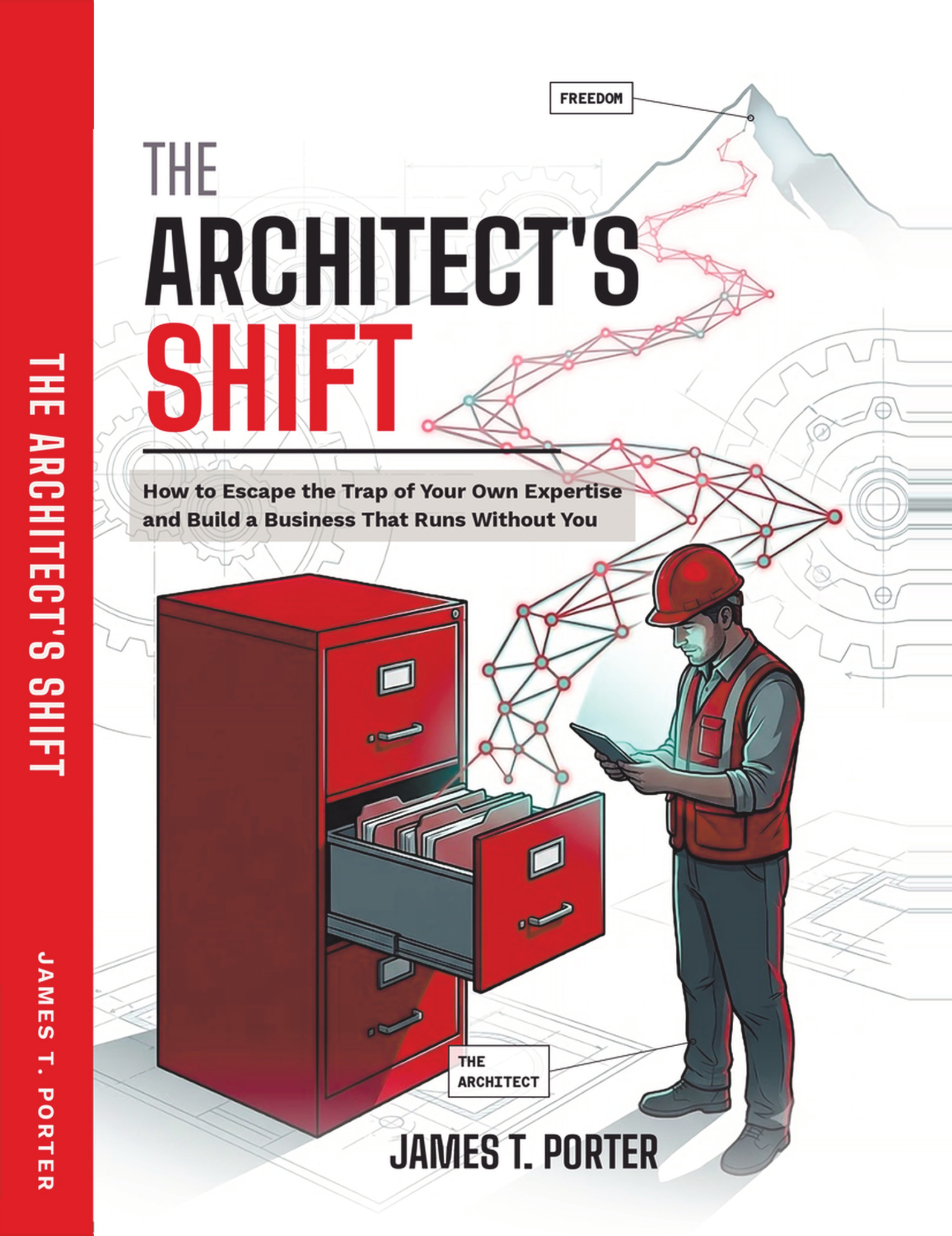
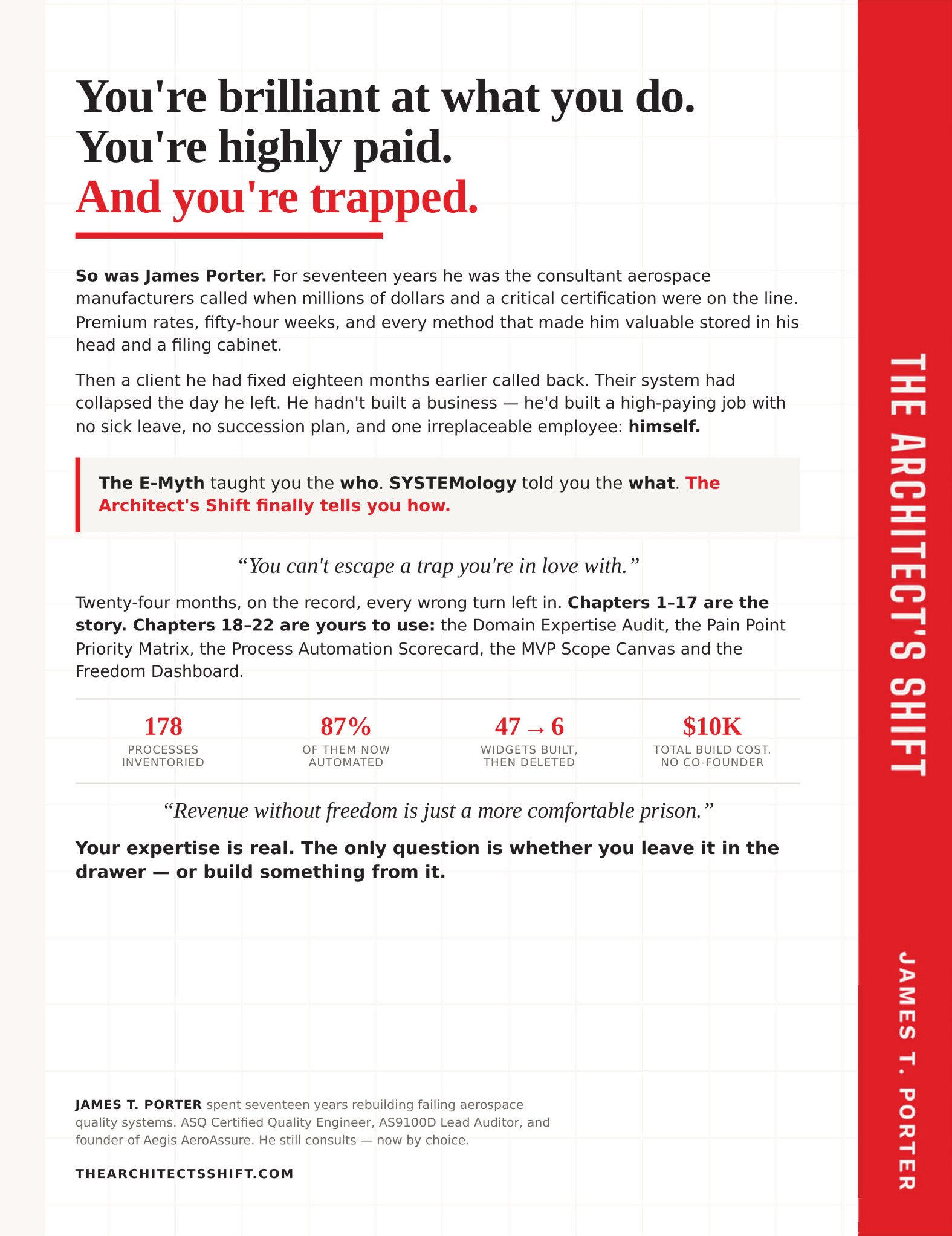
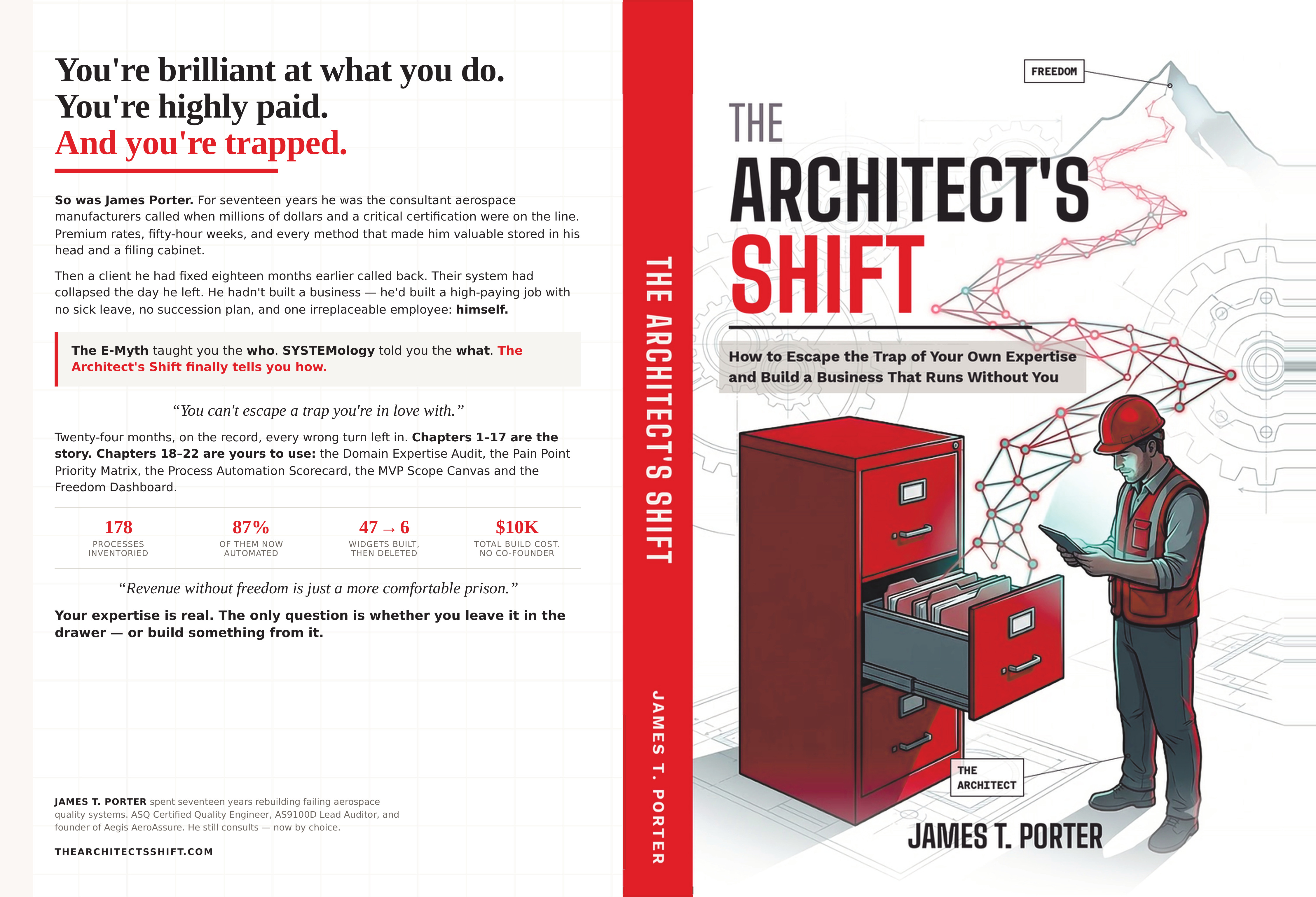
The full story behind The Architect’s Shift: how seventeen years of aerospace quality turnarounds led to a method for getting expertise out of one person’s head, and why every successful rescue eventually broke again for the same reason.
Listen to the episode →Three lengths, cleared for use as written. Copy whichever fits the space.
James T. Porter is an aerospace quality engineer, the author of The Architect’s Shift, and the developer of the Porter FMEA-R, PLR and PCSI supply chain resilience frameworks.
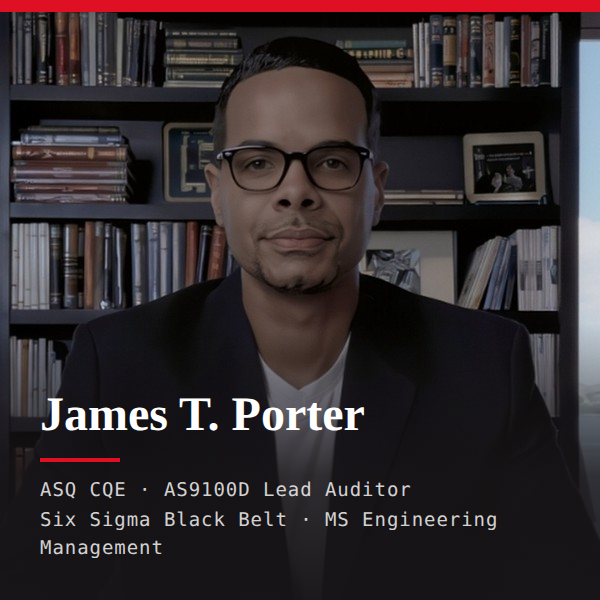
James T. Porter has spent seventeen years inside aerospace quality — a decade at an investment castings house, then supplier quality and supplier development roles at major aerospace OEMs. He is the author of The Architect’s Shift and the developer of three original supply chain resilience frameworks: the Porter FMEA-R, the PLR Equilibrium Model and the PCSI Model. He holds the ASQ Certified Quality Engineer credential, AS9100D Lead Auditor, a Lean Six Sigma Black Belt, and an M.S. in Engineering Management from Penn State.
James T. Porter spent seventeen years as the person aerospace companies called when a supplier quality system was in freefall and contracts worth millions were on the line. He began with a decade as a quality engineer at an investment castings house, then led supplier quality and supplier development programs at major aerospace OEMs — walking into broken systems, rebuilding them in about ninety days, and walking out.
Every turnaround worked. Every one eventually broke again, because the system was him. That pattern produced two bodies of work. The Architect’s Shift is the method for getting an expert’s knowledge out of their head and into something that runs without them. The Porter Aerospace Supply Chain Resilience Series — FMEA-R, PLR and PCSI — is the technical answer to the failure he kept meeting: an industry that scores prevention meticulously and never scores recovery at all.
He holds the ASQ Certified Quality Engineer credential (#101200), AS9100D Lead Auditor, a Lean Six Sigma Black Belt, and an M.S. in Engineering Management from Pennsylvania State University.
Free to use in any coverage, interview listing or event page. No permission needed; a credit line is welcome but not required. Click any one to download it at full size.


Each of these is a position I will defend on the record, not a topic area. Pick one and I will bring the case, the numbers and the argument against me.
Aerospace scores prevention meticulously and never scores how long it takes to come back. Why a perfect FMEA passed three surveillance audits and still could not prevent a sixteen-month outage.
The contrarian version of the supply chain story: the 2021–2023 crisis was not an argument against Lean, it was an argument against running one inventory policy across components whose recovery times differ by two orders of magnitude.
Termination voids the certification envelope, not just the contract. Why the punitive reflex costs more than the defect, and what engineering-led rehabilitation looks like instead.
Seventeen years of turnarounds that all worked and all broke again for the same reason. Extracting a career’s expertise into systems — what it actually takes, and what it costs.
And what it is not. A practitioner’s account, including the parts that went badly, from someone who has to answer to an auditor.
The discipline measures defects, capability and cost of quality. It has almost no accepted measure of how fast an organization recovers — and that gap is where programs die.
Corrective actions close on paper and recur in production because closure is a signature rather than evidence of effectiveness. What proof-based closure actually requires, and why 30/60/90-day verification is the step everyone drops first when the schedule tightens.
Most failing plants do not lack procedures — they lack a scorecard, an action register with owners, and a meeting where decisions get made. Why the operating rhythm is the intervention, and why installing it takes days rather than quarters.
Interviews, podcasts, speaking
james@thearchitectsshift.com
linkedin.com/in/james-t-porter
I answer my own email and I read everything. If you are on a deadline, say so in the subject line and it moves to the top.
Editors & reviewers
Full manuscripts for FMEA-R, PLR and PCSI are available on request, along with the
worked case studies and the standards crosswalks.
Request the manuscripts →
Available for contributed articles, technical review, conference sessions and panel work on aerospace supplier quality, supply chain resilience and AS9100D risk management.